A major court case in West Virginia could affect how states across the country handle religious exemptions, parental rights, and medical freedom.
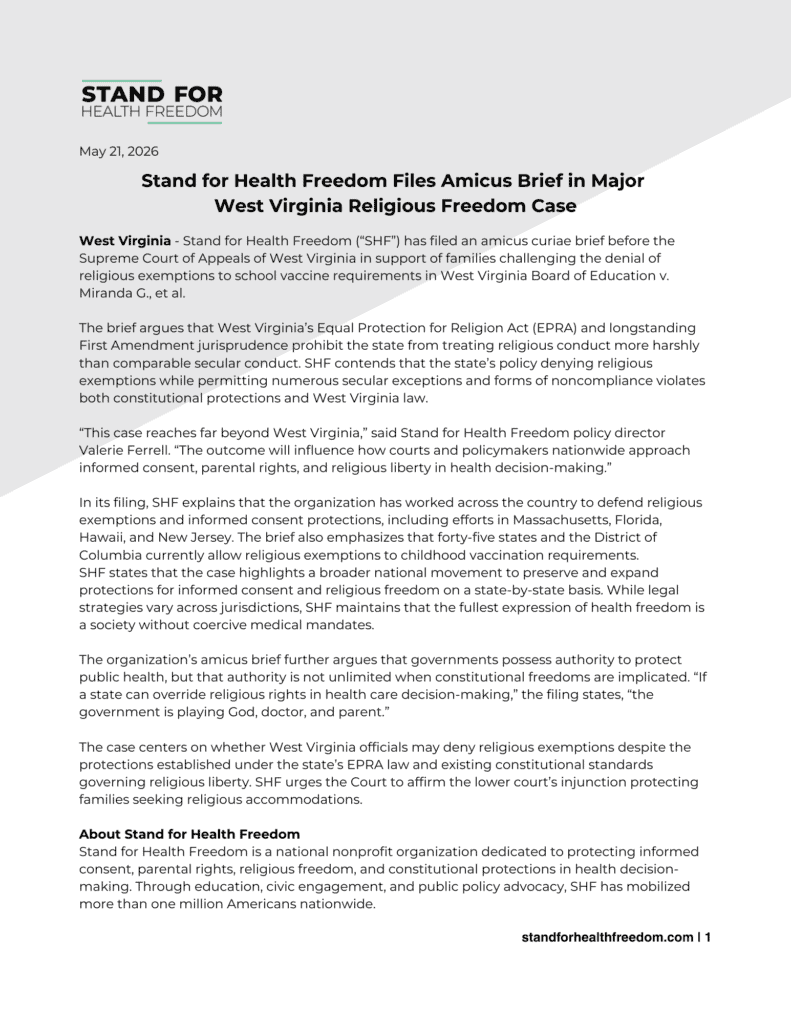
Stand for Health Freedom (“SHF”) recently filed an amicus curiae brief, also called a “friend of the court” brief, with the Supreme Court of Appeals of West Virginia. The brief supports families challenging the denial of religious exemptions to school vaccine requirements in West Virginia Board of Education v. Miranda G., et al.
The case focuses on whether state officials can deny religious vaccine exemptions even though West Virginia law and the U.S. Constitution protect religious freedom.
What SHF Is Arguing
In its brief, SHF argues that the state cannot treat religious families more harshly than others while claiming the policy is necessary for public health.
According to SHF, the West Virginia Board of Education allows many situations that expose students to unvaccinated individuals, while at the same time denying religious exemptions to a small number of students.
For example, schools allow unvaccinated adults, including teachers and coaches, to work closely with students. Schools also host public events and activities involving people from states with no vaccine requirements. SHF argues these situations create the same or even greater exposure risks than the religious exemptions being challenged in the case.
Because of this, SHF says the state’s policy is inconsistent and unfair toward religious families.
The organization also argues that West Virginia’s Equal Protection for Religion Act (“EPRA”) and existing First Amendment protections do not allow the government to single out religious beliefs for unequal treatment.
Why the Case Matters Beyond West Virginia
SHF says the outcome of the case could influence courts and lawmakers across the country.
“This case reaches far beyond West Virginia,” said Stand for Health Freedom Policy Director Valerie Ferrell. “The outcome will influence how courts and policymakers nationwide approach informed consent, parental rights, and religious liberty in health decision-making.”
The organization’s brief also points out that forty-five states and the District of Columbia currently allow religious exemptions for childhood vaccination requirements.
SHF says the case reflects a larger national effort to protect informed consent and religious freedom in health care decisions.
A Bigger Debate About Government Power
The brief argues that while states do have the authority to protect public health, that power should have limits when constitutional rights are involved.
“If a state can override religious rights in health care decision-making,” the filing states, “the government is playing God, doctor, and parent.”
SHF is asking the Court to uphold the lower court’s decision protecting families seeking religious accommodations under West Virginia law.
As the case moves forward, many people across the country are watching closely because the final decision could shape future debates over vaccine mandates, religious liberty, and parental rights for years to come.