That catalyst took form when Stand for Health Freedom, on behalf of our one million-plus advocates, filed a landmark lawsuit against the Centers for Disease Control and Prevention (CDC), demanding a long-overdue review of the childhood vaccine schedule, thus exposing how sweeping public-health policies have been insulated from meaningful oversight. The lawsuit created a shift: agencies once shielded from scrutiny are now being compelled to answer to parents, patients, and the Constitution they serve.
At the heart of the case are clear claims, and equally clear remedies, aimed at restoring lawful, accountable public health governance. The lawsuit:
- Challenges unlawful delegation of authority: The lawsuit asserts that the CDC and ACIP have exercised de facto lawmaking power over the childhood vaccine schedule without proper congressional authorization or accountability.
- Exposes lack of cumulative safety review: It exposes the fact that the CDC has never conducted a comprehensive, cumulative safety analysis of the full childhood vaccine schedule, despite its sweeping, nationwide impact.
- Challenges procedural violations: The suit claims the CDC failed to follow required administrative and procedural safeguards, including transparency, public participation, and reasoned decision-making.
- Demands adherence to informed consent principles: It argues that policies driving mandates undermine informed consent by coercing compliance rather than ensuring voluntary, informed medical decision-making.
- Seeks declaratory and injunctive relief: The lawsuit asks the court to declare the CDC’s actions unlawful and to prohibit enforcement of the schedule until proper review and procedures are followed.
- Seeks restoration of lawful governance: Ultimately, the remedy sought is not to ban vaccines, but to require the CDC to operate within constitutional limits, conduct proper safety reviews, and restore accountability to public health governance.
ACIP votes to remove the controversial birth dose of Hep B vaccine.
On December 4–5, 2025, the CDC’s Advisory Committee on Immunization Practices (ACIP) met to discuss the long-standing recommendation for a universal Hepatitis B birth dose, the evolution of the CDC’s recommended childhood schedule, and comparisons between the U.S. vaccine schedule and those of other countries, including Denmark. For the first time in years, ACIP member comments, agenda items, and votes openly acknowledged concerns about vaccine mandates, questioned one-size-fits-all approaches, and signaled a willingness to reexamine long-standing assumptions underlying the schedule, including the safety of aluminum adjuvants, marking an unmistakable paradigm shift from prior rubber-stamp practices.
ACIP voted to recommend individual-based decision-making, in consultation with a healthcare provider, for parents determining when or if to administer the Hepatitis B vaccine for infants born to HBsAg-negative women. If parents choose to vaccinate, ACIP suggests delaying administration until at least two months of age. The committee also voted to recommend serologic testing prior to administering a second dose, implicitly acknowledging that immune response and physiology vary from child to child.
Sex, Drugs, and Babies? Why were newborns given the Hep B vaccine to begin with?
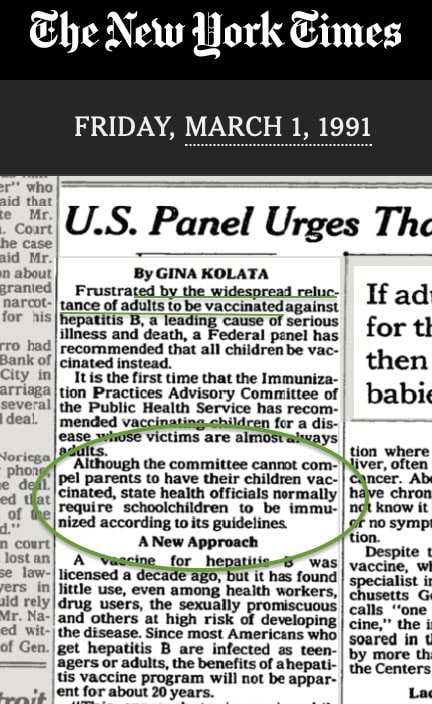
In 1991, The New York Times reported that the Hepatitis B vaccine, originally intended for high-risk adults such as health care workers, injection drug users, and the sexually promiscuous, was added to the childhood immunization schedule not because infants were uniquely vulnerable, but because adults most at risk were not getting vaccinated and school mandates provided a convenient enforcement mechanism.
The article acknowledged this explicitly, stating:
“Although the [ACIP] committee cannot compel parents to have their children vaccinated, state health officials normally require school children to be immunized, according to its guidelines.”
School mandates turned children into captive recipients.
As noted in last month’s Guarding Liberty and in SHF’s recent article What Congress Knew in 1986: The Hidden History of Vaccine Injury Policy, it was widely acknowledged that the National Childhood Vaccine Injury Act (NCVIA) was passed in order to establish a program to compensate those children who are injured while complying with state vaccine mandate laws. Only five years after NCVIA was created to compensate children harmed by such mandates, a vaccine for at-risk adults was added to the childhood schedule and eventually recommended to day-old babies.
While Stand for Health Freedom’s lawsuit against the CDC aims to end unaccountable federal control over the childhood vaccine schedule, state legislatures can and should take action to protect children from policies that undermine parental rights and informed consent.
Passing the Medical Freedom Act ensures parents, not bureaucracies, retain the authority to make medical decisions for their children without coercion or penalty.
For further information on this topic and more, see our Guarding Liberty page, just for you, here. We stand ready to be a resource as you consider this critical legislation.